 My Chord Finder
GUITAR · STANDARD TUNING
Guitar chord inversions
Pick a chord and string group. Compare which chord tone is lowest, then hear and take away the exact shape.
INVERSION WORKBENCH
CRoot position · strings 3–2–1
Standard tuning · E2 A2 D3 G3 B3 E4
Fret codes run from string 6 to string 1.
Finger row: suggested finger — 1 index · 2 middle · 3 ring · 4 pinky; – not fretted. A bar means one finger holds several strings.
SELECTED SOUND
C · root position
Frets: calculating…
Sounding notes: calculating…
Lowest sounding note: calculating…
| String | Fret | Pitch | Chord tone |
|---|
What this checks: the lowest played pitch names the inversion. Every selected fret is applied to standard tuning, then the sounding pitches are checked against the selected chord. Shapes are limited to twelve frets and a four-fret span. If a string group has no matching shape in that range, choose another group. A pitch-valid diagram does not promise a comfortable fingering.
SAME CHORD, DIFFERENT BASS
Compare every inversion on these strings
| Position | Bass | Frets · 6 to 1 | Sounding notes | Open |
|---|
A different voicing can repeat or spread the same notes without changing the bass. This table changes the bass chord tone, so each row is an inversion rather than a new chord quality.
READ THE BASS FIRST
How inversions work on guitar
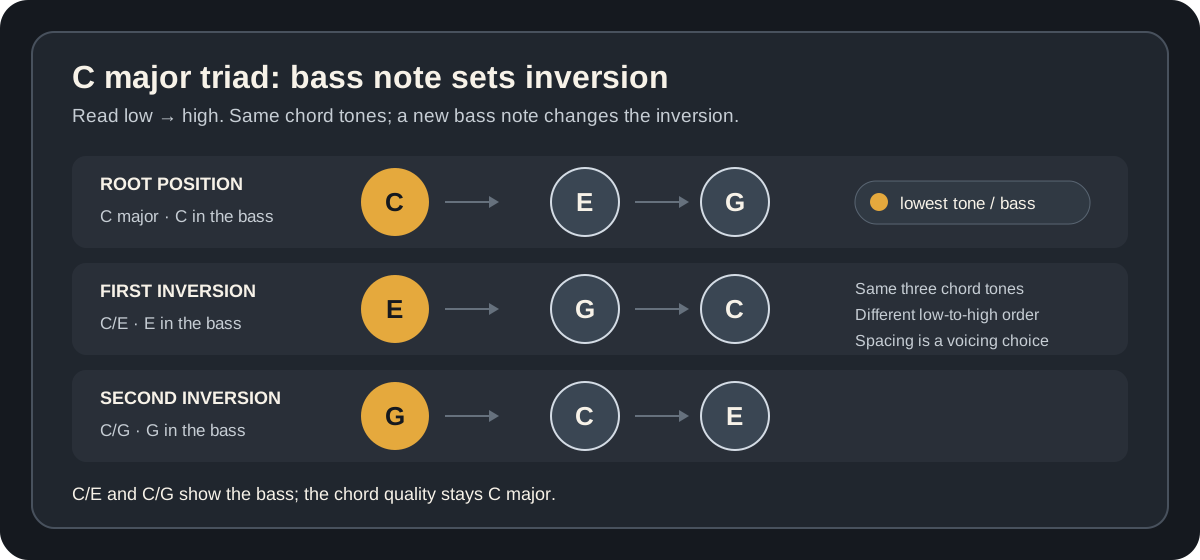
A major triad contains a root, major third, and fifth. Root position puts the root lowest; first inversion puts the third lowest; second inversion puts the fifth lowest. Seventh chords add a seventh and have a third inversion with that seventh in the bass. The chord tones stay the same while the bass changes.
Above that bass, a guitar voicing may place the remaining chord tones in another order or octave. This matters especially for seventh chords: a compact four-string grip can still be first inversion even when its upper notes are not a close-position stack. The actual lowest pitch, not the diagram's highest note or a remembered fret pattern, determines the inversion.
On guitar, choose a set of adjacent strings and compare the actual sounding pitches. A fret number alone cannot tell you the inversion: each string starts at a different open pitch. The workbench adds each fret to the standard-tuning pitch, checks the chord tones, and labels the lowest played note. Use the guitar chord finder when you need more six-string candidate voicings or a separate bass note; this page holds the inversion and its exact three- or four-string shape together.
Chord inversions on guitar become easier to read when the fret code, sounding pitch, and bass are shown side by side. This calculator derives all three from the selected strings rather than assuming that a familiar shape has the same bass after moving it to another string group.
Three checked C major shapes
On strings 3–2–1, the calculator gives C root position X X X 5 5 3 with C4–E4–G4. First inversion is X X X 9 8 8 with E4–G4–C5; second inversion is X X X 0 1 0 with G3–C4–E4. The three results use the same chord tones and string group, while the lowest pitch changes from C4 to E4 to G3. Their fret spans are 2, 1, and 1 respectively, computed as the highest played fret minus the lowest played fret; that number is a geometric check, not a finger-placement guarantee.
The seventh-chord search keeps the chosen bass but allows the upper chord tones to change order, which gives a tighter four-string shape. On strings 4–3–2–1, Cmaj7/E at X X 2 4 1 3 sounds E3–B3–C4–G4 and spans three frets. C7/Bb at X X 8 9 8 8 sounds Bb3–E4–G4–C5 and spans one fret. E and Bb are the actual lowest pitches in those results; neither label is guessed from the highest note or the visual outline.
Guitar chord inversions chart
The comparison table above is a live chart for the selected root, quality, and string group. Pick major or minor triads for three-string shapes; choose a seventh quality for four-string shapes. The exact notes and frets come from this tool, so a generic chart position is never silently reused after changing strings.
COMMON QUESTIONS
Guitar inversion questions
What is a guitar chord inversion?
It is the same chord with a different chord tone as the lowest sounding note. For a major triad, the root, third, or fifth can be lowest. Look at the actual played strings and pitches before naming it.
Is an inversion the same as a voicing?
No. Inversion tells you which chord tone is lowest. Voicing describes how the chord tones are spaced or doubled above that bass. Several guitar shapes can share one inversion.
Can I play a triad inversion on any three strings?
These examples use adjacent three-string groups in standard E–A–D–G–B–E tuning. Select a group to see its checked frets. A shape copied to another group can change its actual pitches and inversion.
How do seventh-chord inversions work?
A seventh chord has four different chord tones. Root position places the root lowest, then the first, second, and third inversions place the third, fifth, and seventh lowest. This tool uses four adjacent strings for those examples.
Why does a band sometimes hear a different inversion?
The lowest note in the full arrangement matters. If a bassist plays a note below the guitar shape, the combined sound may have a different bass from the guitar-only diagram. This chart labels the guitar's own lowest sounding note.