 My Chord Finder
Country chord progression
Hear bass and chords. Take the practice notes or MIDI.
Choose a bar to read its beats
Sounding key: G major · 4 bars · 4/4
Simplified quarter-note preview · no melody or drums. Standard tuning. Frets are relative to the capo.
Your shapes and sounding pitches
Read fret codes from string 6 to string 1. X means mute that string in the held chord. A separate bass pick may use a string outside that held shape. Upper chords use strings 4–3–2–1.
| Bar | Sound / shape | Frets · 6 to 1 | Beat 1 · root | Beat 3 · fifth | Beats 2 and 4 · upper chord |
|---|
A country guitar progression you can practise
Country guitar chords become a rhythm exercise when you give the bass and the upper chord different beats. Choose a pattern above, read the four chord names, then play one chord per bar. The preview is a straight quarter-note exercise with sampled acoustic guitar; a full song can use a different rhythm, voicing or arrangement.
Four patterns, two shape families
| Degrees | G shapes · no capo | C shapes · no capo |
|---|---|---|
| I–IV–I–V | G–C–G–D | C–F–C–G |
| IV–I–V–I | C–G–D–G | F–C–G–C |
| I–V–vi–IV | G–D–Em–C | C–G–Am–F |
| I–vi–IV–V | G–Em–C–D | C–Am–F–G |
These are shared harmonic building blocks, not a country-only vocabulary. A country music chord progression can share its chord order with pop or folk. Here, the exercise focuses on alternating bass and upper chords. The pattern names describe this workbench's practice rows; they do not prescribe the verse or chorus of a particular song.
Read the bass-and-chord cycle
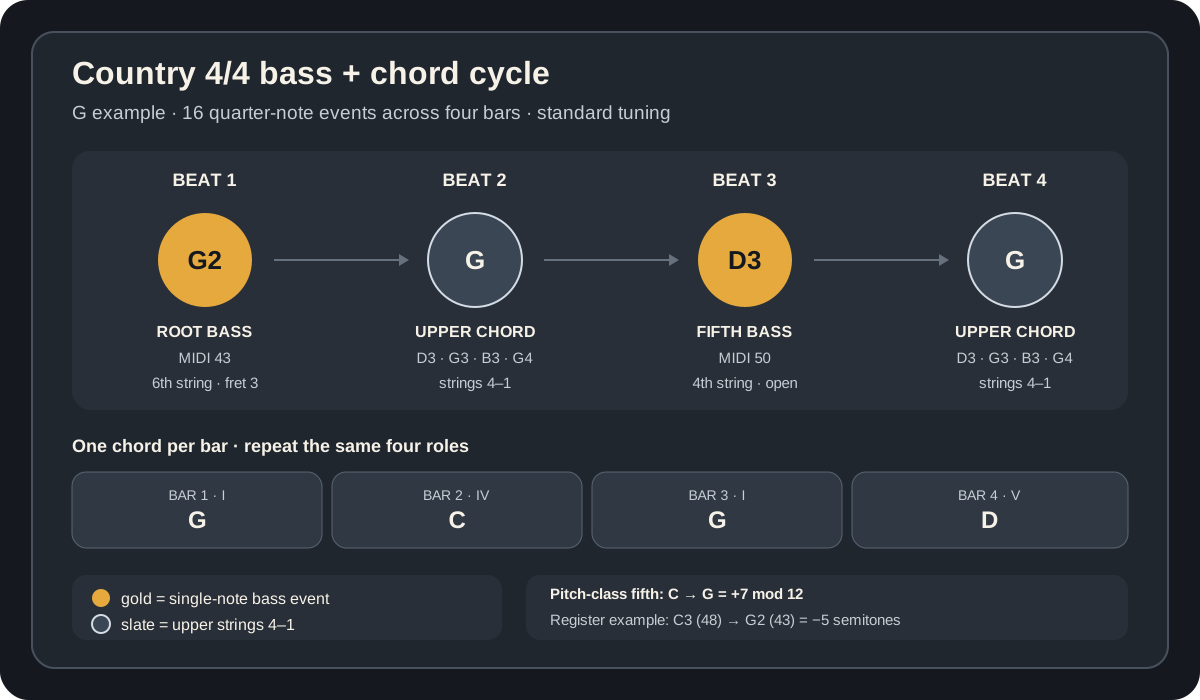
The workbench gives each of its four chords one bar, so four bars times four beats makes sixteen quarter-note events. Each bar starts with one root-bass note, plays four upper-chord notes on beat two, switches to one fifth-bass note on beat three, and repeats the upper chord on beat four. That makes ten note attacks per bar and forty note attacks in the complete preview. The notes on chord beats come from strings four, three, two and one of the selected shape; bass beats are separate single-string picks.
Six checked shapes and their bass notes
With no capo, the G shape 3 2 0 0 0 3 puts its root at string six, fret three: G2, MIDI 43. Its fifth pick is the open fourth string, D3, MIDI 50. The upper G chord sounds D3–G3–B3–G4. The C shape X 3 2 0 1 0 uses C3, MIDI 48, at string five, fret three for its root; its upper chord sounds E3–G3–C4–E4.
For the C bar's third beat, string six, fret three gives G2, MIDI 43, even though that string is muted in the held C shape. Pick it separately, then leave it out of the upper chord. C3 to G2 moves downward by five semitones: 43 minus 48 equals minus five. The pitch-class interval is still a fifth, because adding twelve gives seven. D uses open string four for D3, MIDI 50, and open string five for A2, MIDI 45; its fifth bass also sits below its root in this exercise.
The Em bar uses open string six for E2, MIDI 40, and string five, fret two for B2, MIDI 47. In the C-shape family, F at 1 3 3 2 1 1 uses F2, MIDI 41, and C3, MIDI 48, as its two bass picks. That F grip is a barre shape. Am at X 0 2 2 1 0 uses A2, MIDI 45, and a separately picked open sixth string, E2, MIDI 40. The displayed frets are shape references, not a promise that every grip fits every hand.
Capo shapes and sounding key
The calculator starts with standard-tuning MIDI pitches 40, 45, 50, 55, 59 and 64, then adds each fret and the capo amount. At capo two, G-shape root 43 becomes 45, A2, while fifth 50 becomes 52, E3. The C shape's root 48 becomes 50, D3, and its separate fifth 43 becomes 45, A2. The plain-verse G shapes still read G–C–G–D under your fingers, but the sounding progression becomes A–D–A–E. The table separates the shape name from the sounding chord name so you can check both.
Take this country song chord progression with you
Copy practice notes includes the selected chord names, shape frets, root and fifth positions, and all sixteen beat events. Download MIDI uses those same events: one beat for each slot, four beats per bar and sixteen beats in total. At eighty BPM, sixteen times sixty divided by eighty makes a twelve-second sequence. The MIDI contains note pitches, timing, tempo and an acoustic-guitar program; it does not encode fret numbers, chord names or a recorded guitar performance.
The browser preview needs sound enabled. MIDI playback depends on the instrument in the app that opens it, so its tone can differ from this page. This workbench does not save your history or require an account. Copy the practice notes or download the MIDI before leaving.
Country progression questions
What is a simple country chord progression?
Start with I–IV–I–V and give each chord one bar. This tool opens with G–C–G–D and a separate bass pick on beats one and three. It is a practice starting point; country songs use many chord orders and rhythms.
Why does a chord list not sound like a country guitar part?
A list gives the harmony but leaves the rhythm open. Try separating the root bass, upper chord and fifth bass, then practise changing chords without losing the pulse. This preview teaches that placement without adding a melody, bass run or drums.
Does the capo change the shape or the chord name?
The written shape stays the same; the sounding pitches and chord names move up. Choose the capo above and read both columns. Fret numbers are measured from the capo, rather than from the guitar's nut.
Why is the C chord's low E string marked X but used for a bass note?
The X applies to the held C shape. For the separate fifth-bass beat, move to fret three on that string to play G. Return to the upper four strings on the next beat. The event table keeps that bass action separate from the full shape.
Can I use these patterns for other genres?
Yes. These major-key progressions also appear outside country. The workbench's country practice angle is the bass-and-chord exercise, not a claim that one chord order belongs to one genre.
Keep practising
Use the chord progression generator for freely edited chord sequences, or the guitar chord finder for other individual shapes. For a different tuning, compare Drop D chords.