One fret, three low strings
The power-chord lane is low D, A, and D. The calculator checks every listed note instead of assuming that a standard-tuning fingering still names the same chord after retuning.
 My Chord Finder
GUITAR · D A D G B E
Lower only the thickest string from E to D. Choose a chord, then check exactly which Drop D strings sound.
DROP D CHORD WORKBENCH
Drop D · D2 A2 D3 G3 B3 E4
One lower string changes; this is not Open D.
Fret codes run from string six to string one. 0 is open; X is muted. Power chords use only the root and fifth.
SELECTED SHAPE
Drop D · 0 0 0 X X X
| String | Fret | Note | Role |
|---|---|---|---|
| 6 · D | O | D2 | Root |
| 5 · A | O | A2 | Perfect fifth |
| 4 · D | O | D3 | Root |
| 3 · G | X | Muted | Silent |
| 2 · B | X | Muted | Silent |
| 1 · E | X | Muted | Silent |
What is checked: each fret is applied to D2–A2–D3–G3–B3–E4 and the resulting pitch classes must match the selected quality. Only the selected strings sound. These are exact-pitch references within fifteen frets, not promises about comfortable fingering.
HOW DROP D CHORDS WORK
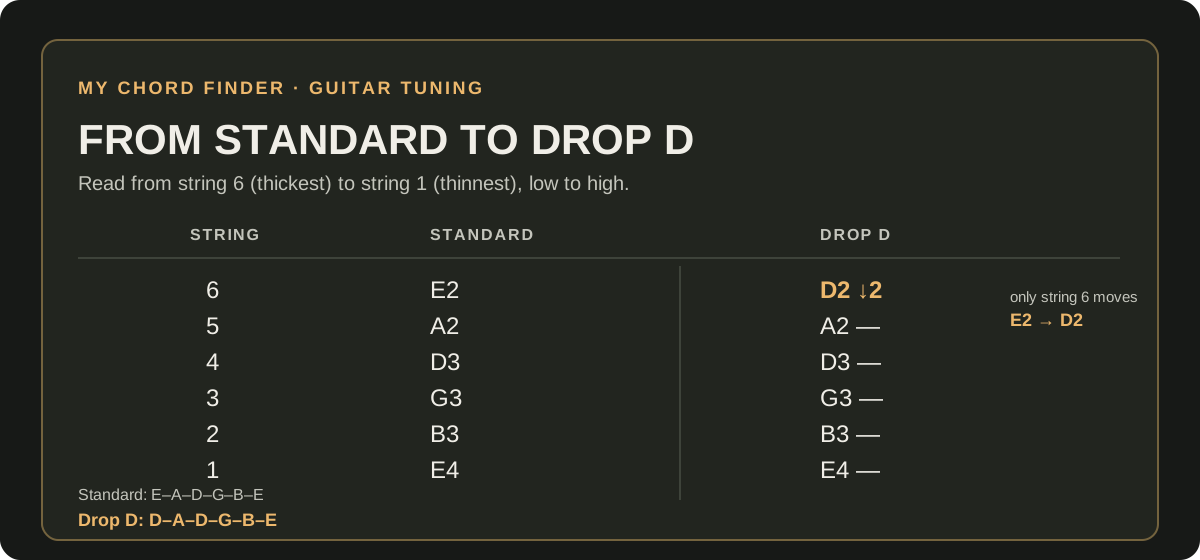
Drop D guitar tuning is D–A–D–G–B–E, low to high. Compared with standard E–A–D–G–B–E, only string six goes down a whole step. Keep the upper five strings at their familiar pitches, but recalculate any standard shape that uses the low string.
For D5, play 0 0 0 X X X: D2, A2, D3. Move the same three-string shape to fret two for E5, 2 2 2 X X X: E2, B2, E3. The root, fifth, and octave move together; the high three strings stay muted. This one-fret alignment is the Drop D power-chord shortcut, not a shortcut for every major or minor chord. The standard-tuning power-chord chart uses a different low-string layout.
Drop D is not Open D. Open D tuning chords use D–A–D–F#–A–D, changing four strings from standard. Strumming all six open strings in Drop D adds G, B, and E to the D–A–D lower group; the result is not a plain D major chord. Check the diagram and note table before naming a full-strum voicing.
Hear shape plays the current exact pitches with recorded guitar samples. Copy shape carries the fret code, sounding notes, and bass. Download chart saves a standalone SVG for that shape; Download MIDI encodes its sounding notes. Changing root or quality updates every output together.
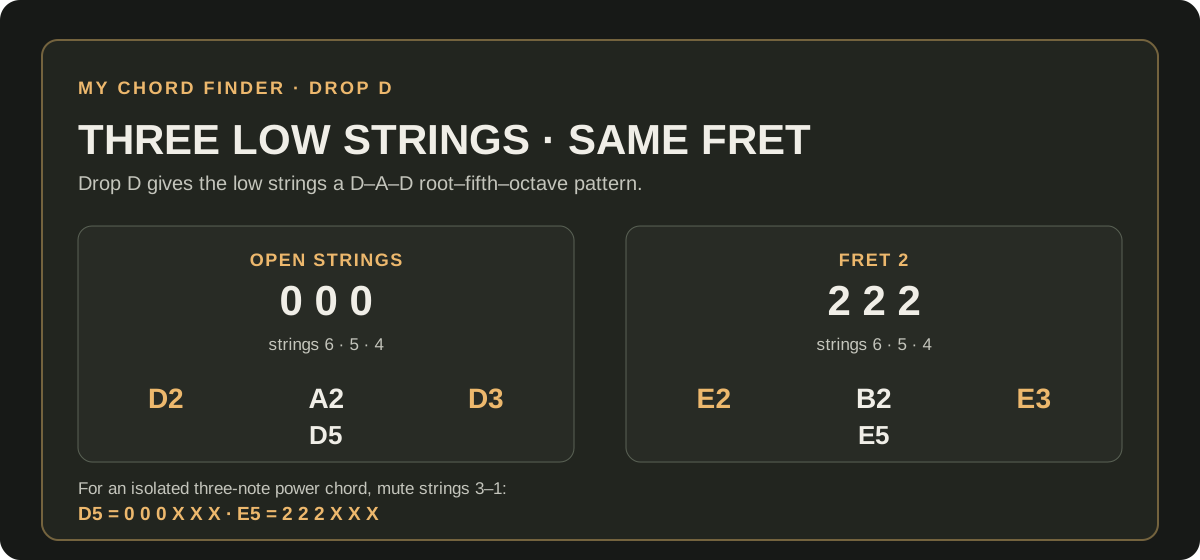
0 0 0 X X XD2 A2 D3
E52 2 2 X X XE2 B2 E3
The power-chord lane is low D, A, and D. The calculator checks every listed note instead of assuming that a standard-tuning fingering still names the same chord after retuning.
Major, minor, seventh, suspended, and extended chords need their own frets or muted strings. Read the exact note table and bass for the selected result; a pitch-valid reference is not a finger-placement guarantee.
Three calculated D-root examples: D major at 0 0 0 2 X 2 sounds D2, A2, D3, A3, F#4. D minor at 0 0 0 X X 1 sounds D2, A2, D3, F4. D7 at 0 0 0 2 1 2 sounds D2, A2, D3, A3, C4, F#4. The exact third and seventh come from the fretted upper strings, not from the low power-chord lane. Lower every string one more whole step and you get Drop C tuning: the same shapes, two semitones lower.
One finger across the low three strings at the same fret gives a power chord. Open is D5, fret 2 is E5, fret 5 is G5, and fret 12 is D5 an octave up. Tap a row to hear it.
| Fret | Chord | Frets (6 → 1) | Notes |
|---|---|---|---|
| 0 | 0 0 0 X X X | D2 · A2 · D3 | |
| 1 | 1 1 1 X X X | D#2 · A#2 · D#3 | |
| 2 | 2 2 2 X X X | E2 · B2 · E3 | |
| 3 | 3 3 3 X X X | F2 · C3 · F3 | |
| 4 | 4 4 4 X X X | F#2 · C#3 · F#3 | |
| 5 | 5 5 5 X X X | G2 · D3 · G3 | |
| 6 | 6 6 6 X X X | G#2 · D#3 · G#3 | |
| 7 | 7 7 7 X X X | A2 · E3 · A3 | |
| 8 | 8 8 8 X X X | A#2 · F3 · A#3 | |
| 9 | 9 9 9 X X X | B2 · F#3 · B3 | |
| 10 | 10 10 10 X X X | C3 · G3 · C4 | |
| 11 | 11 11 11 X X X | C#3 · G#3 · C#4 | |
| 12 | 12 12 12 X X X | D3 · A3 · D4 |
Lower every string three more half steps and the same chart works in Drop B tuning.
Only string 6 moves. Pick the open D string (string 4) and lower string 6 until it sounds the same note an octave down. To check, play string 6 at fret 7: it should match the open A string. Then retune the other strings, because the neck relaxes a little.
Drop D is D2, A2, D3, G3, B3, E4 (MIDI 38, 45, 50, 55, 59, 64). In a window that starts at 11.25 seconds and lasts 0.80 seconds, D2 is 73.43 Hz and A2 is 110.05 Hz. 110.05 ÷ 73.43 = 1.49871. Equal temperament for 7 semitones is 2^(7 ÷ 12) = 1.49831, so this fifth is 0.5 cents against equal temperament. A pure 3/2 fifth is 1.50000, and this fifth is -1.5 cents against that. D2 (MIDI 38) is 440 × 2^((38 − 69) ÷ 12) = 73.42 Hz. The same window also shows E4 330.10 Hz, G4 392.17 Hz, B3 246.86 Hz, G3 196.11 Hz.
Raoul NK recorded these open strings. Source: Wikimedia Commons, File:Guitar Drop-D Tuning.ogg. License: CC BY-SA 3.0. This recording is shared under the same license.
COMMON QUESTIONS
Only the thickest string changes: tune standard E2 down to D2. The other strings remain A2, D3, G3, B3, and E4.
No. The same-fret low-three-string shape makes a power chord, such as D5 at 0 0 0 X X X or E5 at 2 2 2 X X X. Other qualities need their own verified positions.
No. Drop D changes only string six from standard tuning. Open D changes the sixth, third, second, and first strings to make D–A–D–F#–A–D.
No. “Drop tuning” can refer to several tunings. These diagrams assume Drop D specifically: D–A–D–G–B–E. Check the six target notes before using this chart for another tuning.
Any chord you play in standard tuning that does not use string 6 stays the same. Power chords on the low three strings take one finger. For chords that use the low D, pick the root and quality in the tool above.
More tunings: DADGAD chords.