 My Chord Finder
0 0 0 0 0 0GUITAR · D A D G A D
DADGAD guitar chords
Choose a root and quality, then read the frets, sounding notes, and bass before you play.
DADGAD CHORD LIBRARY
Dsus40 0 0 0 0 0
DADGAD · D2 A2 D3 G3 A3 D4
Strings are read low to high: 6 to 1.
Fret codes run from string 6 to string 1. Zero means open; X means muted.
PRACTICE LOOP
Four chords you can play
One chord per bar · 80 BPM
0 0 4 2 0 05 5 0 0 2 00 0 4 2 0 0SELECTED SHAPE
Dsus4
Bass D2 · frets 0 0 0 0 0 0
Copy practice includes the selected chord and four-card loop. Chart SVG is the selected chord; Progression MIDI follows the four cards and tempo.
| String | Fret | Note | Role |
|---|---|---|---|
| 6 | 0 | D2 | Root |
| 5 | 0 | A2 | Perfect fifth |
| 4 | 0 | D3 | Root |
| 3 | 0 | G3 | Perfect fourth |
| 2 | 0 | A3 | Perfect fifth |
| 1 | 0 | D4 | Root |
Finger row: suggested finger — 1 index · 2 middle · 3 ring · 4 pinky; – not fretted. A bar means one finger holds several strings.
Checked output: the page compares each selected fret shape against D–A–D–G–A–D, then shows the resulting pitches and chord role. A DADGAD shape is a pitch reference; it does not promise one fingering for every hand.
Easy DADGAD chords in the key of D
Many DADGAD tunes are in D, so these are the chords you meet first. Each shape keeps some open strings ringing, which is the sound people tune to DADGAD for. Tap a row to hear it.
| Chord | Role | Frets (6 → 1) | Notes |
|---|---|---|---|
| I | 0 0 4 2 0 0 | D2 · A2 · F#3 · A3 · A3 · D4 | |
| ii | 2 2 2 0 2 2 | E2 · B2 · E3 · G3 · B3 · E4 | |
| iii | 4 0 4 X 4 4 | F#2 · A2 · F#3 · C#4 · F#4 | |
| IV | 5 5 0 0 2 0 | G2 · D3 · D3 · G3 · B3 · D4 | |
| V | X 0 2 2 4 X | A2 · E3 · A3 · C#4 | |
| vi | X 2 0 4 5 4 | B2 · D3 · B3 · D4 · F#4 | |
| open | 0 0 0 0 0 0 | D2 · A2 · D3 · G3 · A3 · D4 |
Start with Dsus4: the all-open shape 0 0 0 0 0 0 sounds D2–A2–D3–G3–A3–D4. The open strings contain D, A, and G, with no third, so the shape is suspended rather than a D major chord.
Practice Dsus4–D–G–D: let the open shape ring, then move to verified D major, G major, and D major shapes. The progression gives you a simple DADGAD loop to hear before choosing another root or quality.
HOW DADGAD WORKS
Tune three strings, then let the open notes guide the shape
From standard E–A–D–G–B–E, lower strings 6, 2, and 1 by two semitones. The result is D–A–D–G–A–D, or D2–A2–D3–G3–A3–D4 from low to high. Strings 5, 4, and 3 stay at their standard pitches.
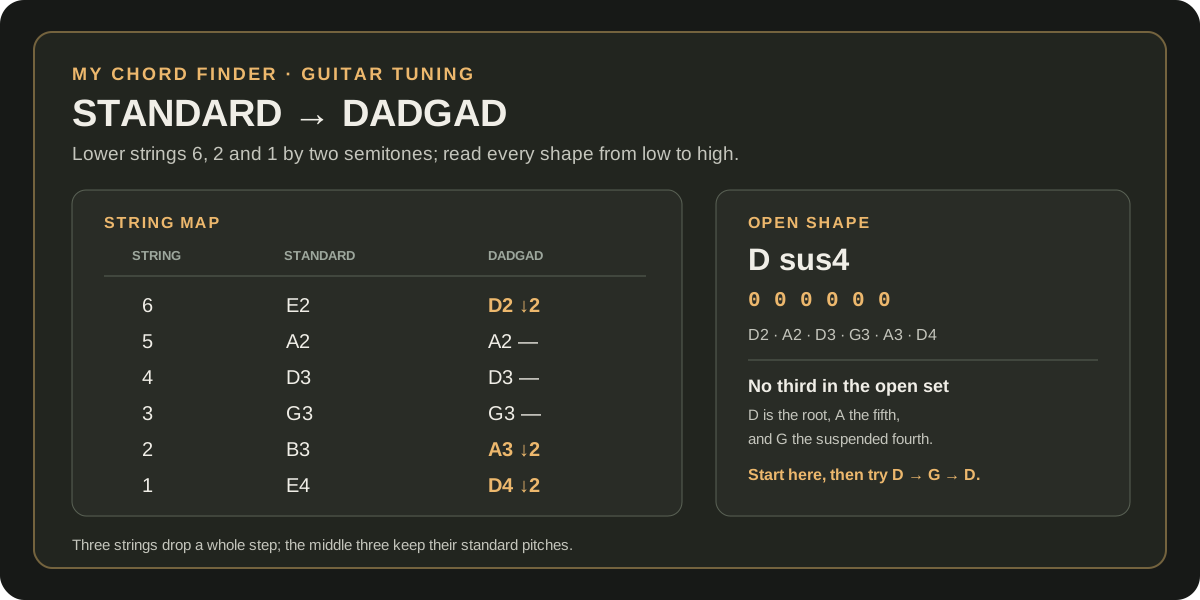
Why the all-open shape is Dsus4
The open notes are D, A, D, G, A, and D. D is the root, A is the fifth, and G is the perfect fourth above D. No F# is present, so the shape has no third; call it Dsus4 rather than D major.
Verified shapes to start with
D major uses 0 0 4 2 0 0 and sounds D2–A2–F#3–A3–A3–D4. G major uses 5 5 0 0 2 0 and sounds G2–D3–D3–G3–B3–D4. Dsus2 uses 0 0 2 2 0 0 and sounds D2–A2–E3–A3–A3–D4.
| String | Standard | DADGAD | Change |
|---|---|---|---|
| 6 | E2 | D2 | Down 2 semitones |
| 5 | A2 | A2 | Unchanged |
| 4 | D3 | D3 | Unchanged |
| 3 | G3 | G3 | Unchanged |
| 2 | B3 | A3 | Down 2 semitones |
| 1 | E4 | D4 | Down 2 semitones |
RECORDINGS
Songs in DADGAD
These three recordings are played in DADGAD (D–A–D–G–A–D). The year is the release year of the record that first carried each one.
| Song | Artist | Year | Tuning |
|---|---|---|---|
| Kashmir | Led Zeppelin | 1975 | DADGAD (D–A–D–G–A–D) |
| Black Mountain Side | Led Zeppelin | 1969 | DADGAD (D–A–D–G–A–D) |
| White Summer | Jimmy Page | 1967 | DADGAD (D–A–D–G–A–D) |
TWELVE ROOTS
DADGAD shapes for every root
The library fills this table for the selected quality across all twelve chromatic roots. Read the shape, then check the sounding notes before you move it into a progression.
| Root | Quality | Frets · 6 to 1 | Sounding notes | Bass |
|---|---|---|---|---|
| C | Sus4 | X 3 3 0 3 3 | C3 · F3 · G3 · C4 · F4 | C3 |
| C# | Sus4 | 11 11 11 11 11 11 | C#3 · G#3 · C#4 · F#4 · G#4 · C#5 | C#3 |
| D | Sus4 | 0 0 0 0 0 0 | D2 · A2 · D3 · G3 · A3 · D4 | D2 |
| D# | Sus4 | 1 1 1 1 1 1 | D#2 · A#2 · D#3 · G#3 · A#3 · D#4 | D#2 |
| E | Sus4 | 2 0 2 2 2 2 | E2 · A2 · E3 · A3 · B3 · E4 | E2 |
| F | Sus4 | 3 3 3 3 3 3 | F2 · C3 · F3 · Bb3 · C4 · F4 | F2 |
| F# | Sus4 | 4 4 4 4 4 4 | F#2 · C#3 · F#3 · B3 · C#4 · F#4 | F#2 |
| G | Sus4 | 5 5 0 5 5 0 | G2 · D3 · D3 · C4 · D4 · D4 | G2 |
| G# | Sus4 | 6 6 6 6 6 6 | G#2 · D#3 · G#3 · C#4 · D#4 · G#4 | G#2 |
| A | Sus4 | X 0 0 2 0 2 | A2 · D3 · A3 · A3 · E4 | A2 |
| A# | Sus4 | 8 8 8 8 8 8 | A#2 · E#3 · A#3 · D#4 · E#4 · A#4 | A#2 |
| B | Sus4 | 9 9 9 9 9 9 | B2 · F#3 · B3 · E4 · F#4 · B4 | B2 |
Check the notes behind these shapes
These readings come from the displayed DADGAD shapes. Add a fret number to its open-string MIDI pitch; X contributes no note. A fret span counts only held frets, so open strings do not increase that span.
The DADGAD default practice plays Dsus4 → D major → G major → D major. Four bars at four beats each make sixteen beats. At 80 BPM, its duration is 12.00 seconds. One attack on every sounding string at each bar start makes 24 note attacks; the MIDI uses the same notes and bar lengths.
COMMON QUESTIONS
DADGAD chord questions
What is DADGAD tuning?
DADGAD is a six-string tuning that lowers strings 6, 2, and 1 by two semitones from standard tuning. The open strings then read D–A–D–G–A–D.
Why is the open DADGAD chord called Dsus4?
The open strings give D, A, and G, but no F#. D is the root, A is the fifth, and G is the fourth, so the open shape is Dsus4 rather than D major.
How do I play D major in DADGAD?
Start with 0 0 4 2 0 0. It sounds D2–A2–F#3–A3–A3–D4 in this tuning.
Can I use DADGAD chords in a progression?
Yes. Try Dsus4–D–G–D first, then select another root or quality above. The progression cards show the shape and the selected tempo together.
Where can I compare another tuning?
Read Open D tuning chords or Open G tuning chords, then use the chord progression generator for freely edited sequences.
What chords sound good in DADGAD?
Chords in the key of D: D, G and A, plus Em and Bm. Open strings ring through most of them, so suspended and add9 sounds come easily. See the key-of-D table above.
What is DADGAD good for?
Fingerstyle and folk playing where open strings drone under a melody. Three open D strings and two open A strings give a steady D drone under many shapes.